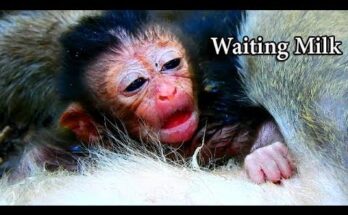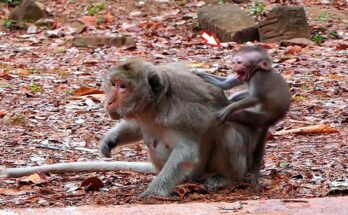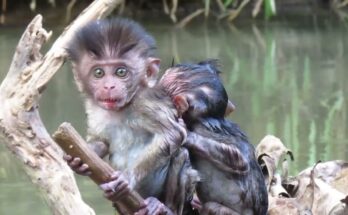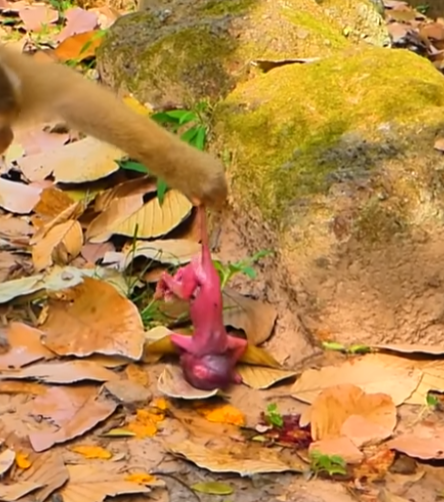
The visit is quiet, marked less by sound than by feeling. Monkey baby Lily arrives first, moving cautiously, as if she senses that something is different. Close behind her is her brother Leo, older and usually playful, but now unusually subdued. Together, they approach the small, heartbreaking presence at the center of the moment—the monkey baby who was stillborn. There is no instinctive excitement, no rough play, only hesitation and a strange, heavy calm.
Lily stops a short distance away. Her curious nature, normally bright and energetic, is tempered by uncertainty. She tilts her head, eyes fixed on the unmoving infant. There is recognition without understanding—something familiar, yet profoundly wrong. Babies are supposed to move, to cling, to cry softly. This one does none of those things. Lily edges closer, then pauses again, as if waiting for a sign that never comes.
Leo remains just behind her, protective in his own quiet way. He seems to understand more than Lily does, or at least he feels the gravity of the situation more deeply. His body language is restrained; his usual confidence replaced with caution. He watches both Lily and the stillborn baby, alert but gentle, as though he knows this moment demands respect.
Neither monkey reacts dramatically. There are no loud cries, no visible panic. Instead, their response is subtle: lowered heads, slower movements, careful glances. It is grief expressed not through display, but through stillness. Animals, like humans, do not always need overt expressions to acknowledge loss. Presence alone becomes a form of recognition.
Lily eventually reaches out, touching the stillborn baby briefly, then pulling her hand back. The moment is fleeting but powerful. Her confusion is evident—she has encountered something that defies her experience. Leo steps closer then, positioning himself between Lily and the infant, a quiet gesture of protection. Not from danger, but from something emotionally overwhelming.
The air feels suspended, as if the world itself is pausing to acknowledge what has been lost. This visit is not about understanding death, but about acknowledging absence. The stillborn baby is not ignored, not discarded without notice. Lily and Leo, in their own instinctive way, recognize that this small life mattered.
In this silent encounter lies a tender truth: grief and compassion are not uniquely human. Even without language or ritual, these young monkeys sense the weight of loss. Their visit, brief and subdued, becomes a gentle farewell—one rooted not in comprehension, but in connection.