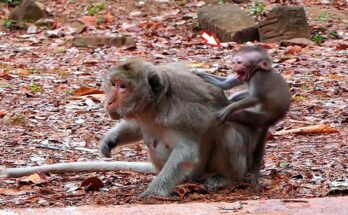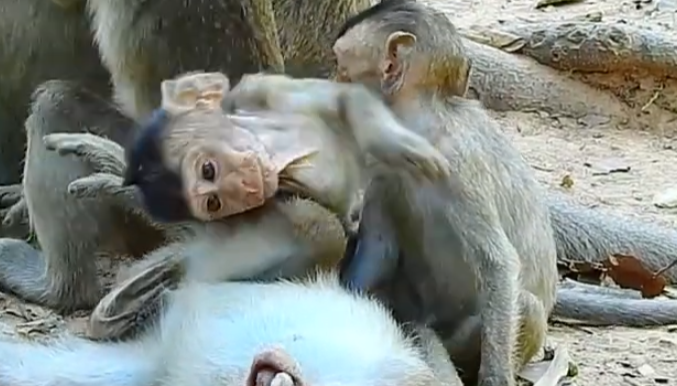
God help… what happened to the little monkey? There he lay, motionless on the ground, his tiny body stretched helplessly across the forest floor. Moments earlier, the jungle was alive with sound—birds singing, leaves rustling, branches swaying with playful movement. Now, silence surrounded him, heavy and filled with worry. His breathing was shallow, so faint it was almost invisible. His small chest barely rose, and his fragile hands rested limply beside him. It was as if the world had suddenly drained the life from someone so young and full of promise.
No one knew what had happened. Maybe he fell from the tree while learning to climb. Maybe he was attacked, weakened by illness, or simply too exhausted to survive another day in the harsh wild. But whatever the reason, seeing him lying there unconscious was heartbreaking. A baby should be swinging happily, clinging to his mother, exploring and learning. Instead, this little soul lay silent, vulnerable, and frighteningly still.
The troop noticed. Monkeys are emotional beings, capable of compassion and concern. One of the adults approached slowly, touching him gently, hoping for a response. Another sat nearby, watching anxiously, as if guarding him. The jungle seemed to hold its breath. Even the wind felt softer, as though nature itself feared to disturb him.
If his mother was near, her heart must have been breaking. A mother’s love never fades, and the sight of a child in danger cuts deeper than anything. She would nudge him, cradle him, and refuse to accept the possibility of losing him. That instinctive hope is powerful—it is the last strength nature gives to those who love deeply.
And yet, in this fragile silence, another hope remains: rescue. Sometimes kind hands, caring hearts, or even another monkey’s protective instinct step in. Somewhere, there is always the chance for warmth, safety, and healing. The world may be harsh, but it is not always heartless.