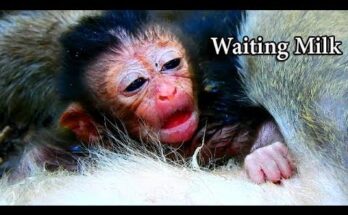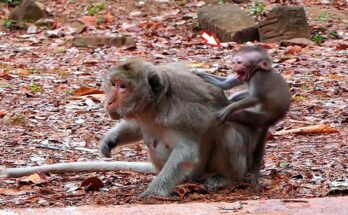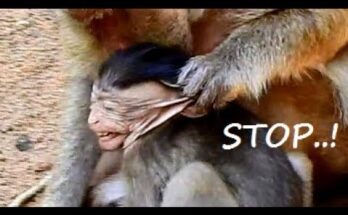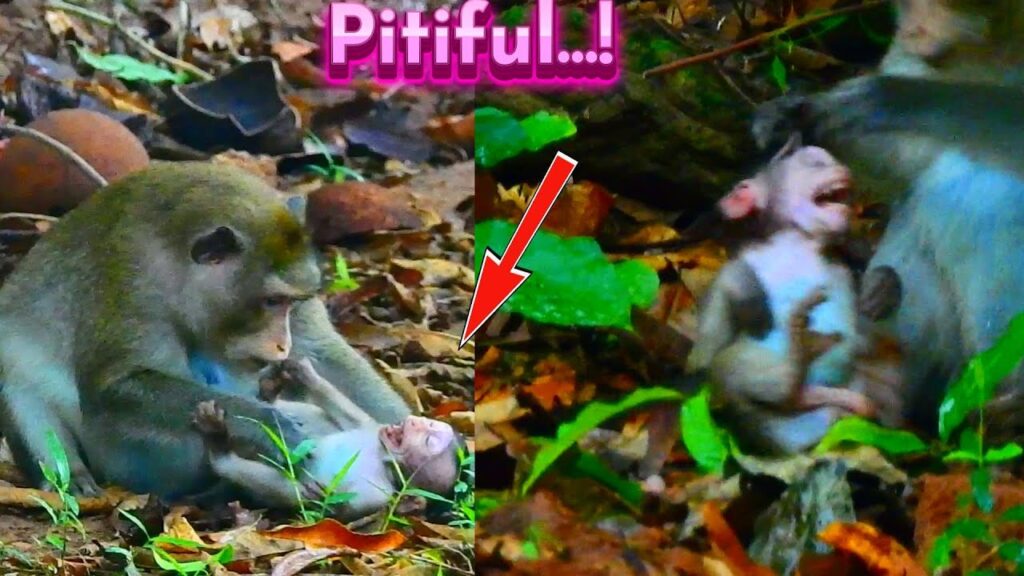
Whose fault is it? That painful question lingered in the air when Leo, who had been having a good time with his mother, suddenly lost consciousness. Just moments earlier, everything felt normal and peaceful. Leo clung to his mother’s side, playful and relaxed, enjoying the simple comfort of being close to her. There was laughter in his movements, energy in his steps, and warmth in the shared moment. No one could have imagined how quickly joy would turn into fear.
Without warning, Leo slowed. His playful motions became unsteady, and his eyes lost focus. Then, in a terrifying instant, his small body went limp. He collapsed softly, as if sleep had taken him too fast. His mother froze, confused by what she was seeing. She immediately moved closer, touching him, nudging him gently, trying to wake him. Panic replaced happiness in her eyes.
Other monkeys nearby sensed the sudden change. The atmosphere shifted from calm to tense. Leo’s mother stayed close, grooming him anxiously, holding him protectively, refusing to leave his side. Leo did not respond. His breathing was shallow, and his body remained still. It was a frightening sight—one that made everyone wonder what could have gone wrong so suddenly.
Was it illness? Exhaustion? Hunger? Heat? Stress? In the wild, answers are rarely clear. There is no way to ask, no way to test, no explanation given. Blame feels natural in moments like this, but often there is no single fault. Nature can be unpredictable and unforgiving, and even the most loving care cannot prevent every danger.
Leo’s mother showed no anger, only worry and devotion. She stayed with him, watching every breath, as if her presence alone could bring him back. Her gentle touches were filled with hope and fear intertwined. She did not know why this happened, only that her child needed her now more than ever.
Watching this unfold was heartbreaking. Leo had been fine seconds before, and now he was unconscious, caught in a fragile space between awareness and darkness. It reminded everyone how delicate life truly is. One unseen problem can change everything without warning.
As time passed, hope remained. Sometimes consciousness returns. Sometimes the body recovers. All that could be done was to wait and care. The forest grew quiet, as if giving them space. In that silence, the question still hung: whose fault is it?
Perhaps the hardest truth is that sometimes there is no fault. No mistake. No one to blame. Only a sudden turn of fate that leaves behind fear, confusion, and love trying desperately to protect what it cherishes most. Leo’s story is a reminder that even the happiest moments can change, and compassion—not blame—is what matters most in the face of the unknown.
Please write 420 words about this: OMG…Hot Event! Shocking Heart!Mother with rabies wants to tear her own child apart.
OMG… it was a shocking and heartbreaking event that left everyone stunned and afraid. The mother monkey, once known for her protective and gentle nature, suddenly began acting in a way no one recognized. Something was terribly wrong. Her movements were erratic, her eyes unfocused, and her behavior filled with agitation and confusion. The most frightening part was that she turned toward her own child, not with care, but with uncontrolled aggression driven by illness.
Rabies is a devastating disease that attacks the brain and nervous system. When it takes hold, it can completely change behavior. Fear turns into aggression, confusion replaces recognition, and instincts become dangerously distorted. This was not cruelty or hatred—it was sickness. The mother no longer understood who her baby was. The bond that should have protected the child was broken by a disease she could not control.
The baby sensed the danger immediately. It cried out in fear, clinging desperately, trying to escape without understanding why its own mother felt unsafe. The cries were filled with panic and confusion. Other monkeys reacted quickly, alarm calls echoing through the area. Some tried to distract the mother, others rushed to protect the baby, knowing something was very wrong.
The scene was emotionally overwhelming. Watching a mother struggle against her own mind, driven by illness to harm what she once loved, was deeply painful. This was not a fight—it was a tragedy unfolding in real time. The mother herself was a victim, trapped inside a body and mind overtaken by disease. Her distress was clear, her movements restless and desperate, as if she too was suffering without understanding why.
In the wild, there is no treatment, no isolation, no way to explain or ease the condition. Rabies often leads to fatal outcomes, not only for the infected animal but also for those around it. That reality makes scenes like this even more heartbreaking. The danger is real, and intervention becomes necessary to protect others, especially the vulnerable.
This shocking event reminds us how fragile life can be and how illness can turn love into fear without warning. It also reminds us not to judge behavior without understanding its cause. The mother did not choose this. She did not want to harm her child. She was overtaken by a disease that stripped away her ability to recognize, reason, and care.
In the end, what remains is sadness—for the baby, for the mother, and for the cruel power of illness. It is a reminder that compassion is needed even in the most frightening moments, because sometimes the most shocking behavior is rooted not in evil, but in unbearable suffering.